
Idaho Producers Supply Mass Timber Arena
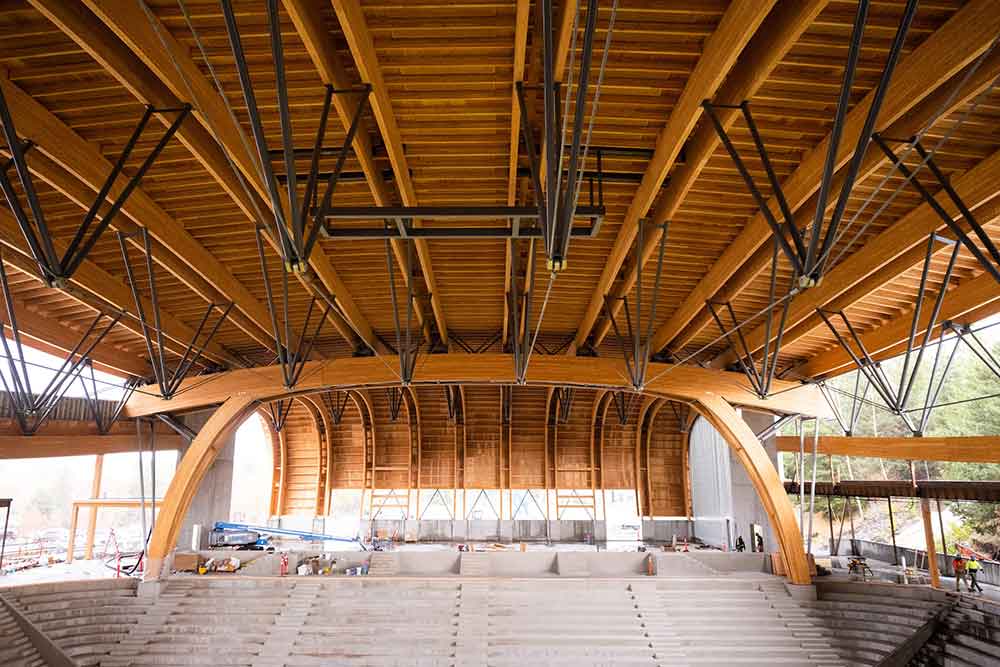
Industry stakeholders of all types worked to supply materials for the recently opened ICCU Basketball Arena at the University of Idaho in Moscow. The 4,000 seat facility, which opened in October 2021, incorporates several innovative mass timber elements across some of the longest spans in the country. Designers and engineers were able to source many of the structural wood products and materials to make them—including cross-laminated timber (CLT), dowel-laminated timber (DLT), glulam, plywood, and cedar siding—from local suppliers and producers.
 Some of the timber used was specifically harvested from the university’s experimental forest. Associated Loggers Council-Idaho board member Mark Swanson, of Swanson Logging in Lewiston, was on hand for the grand opening. Aaron Walter Logging, Frederickson Logging, Jack Buell Trucking and other contractors also participated in the effort.
Local manufacturers that supplied wood products included Boise Cascade, PotlatchDeltic, QB Corp., Idaho Forestry Group and Tri-Pro Cedar Products. The structural engineer of record was StructureCraft, which fabricated the roof structure and associated timbers and specialty engineered wood components.
The facility is noted for its use of EWPs in innovative ways, such as a plywood roof diaphragm that clear-spans 250 feet from end-to-end of the arena and acts as the lateral bracing system for both wind and seismic loads. A review in an architectural paper explains that the building incorporates “a hybrid structural system comprising glulam beams, steel king-post trusses, and concrete shear walls that rises to form a broad canopy over a cast-in-place concrete seating bowl, itself ensconced in a trim of zinc-and-glass curtain wall.”
Designers pursued a rolling geometric motif reflecting the surrounding Palouse region’s channeled scablands created by cataclysmic floods at the end of the Ice Age.
Latest News
Oregon Cascades Study May Rewrite The Textbook On Forest Growth, Death
A century-long study in the Oregon Cascades may cause scientists to revise the textbook on how forests grow and die, accumulate biomass and store carbon. In a new analysis of forest succession in...
USFS Study: Post-Fire Logging Can Reduce Fuels Up To 40 Years In Restoring Forests
Harvesting fire-killed trees is an effective way to reduce woody fuels for up to four decades following wildfire in dry coniferous forests, a U.S. Forest Service study has found. The retrospective...
WANT MORE CONTENT?
Spanning seven decades since its inception in 1952, Timber Harvesting highlights innovative and successful logging operations across the U.S. and around the world. Timber Harvesting also emphasizes new technology and provides the best marketing vehicle for the industry’s suppliers to reach the largest number of loggers in North America and beyond.
Call Us: 800.669.5613