
March / April 2026
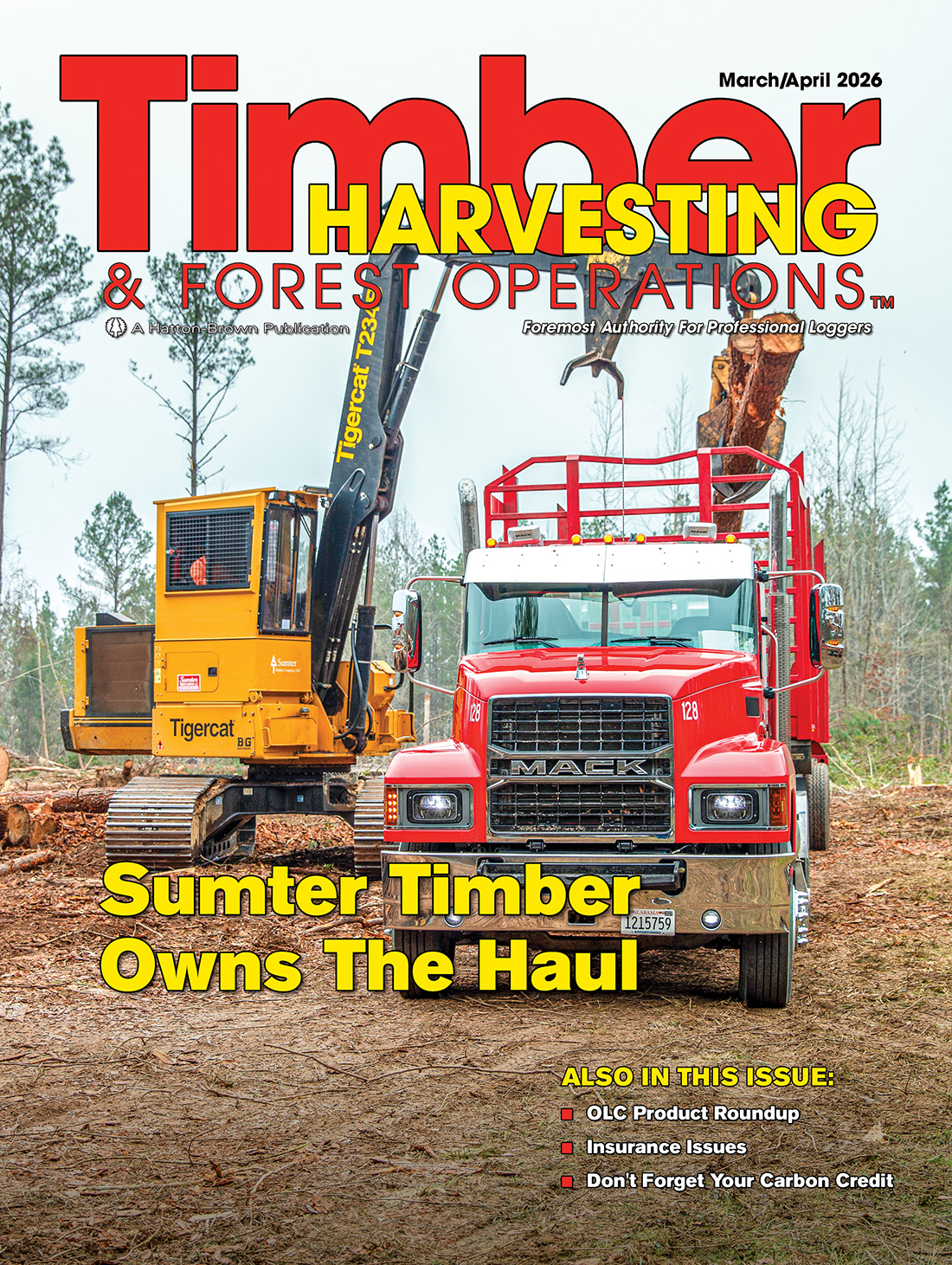
Sumter Timber Owns The Haul
Alabama’s Sumter Timber focuses on trucking efficiency and productivity.
INSIDE THIS ISSUE
COVER STORY
Sumter Timber Owns The Haul
NEWSLINES
- Ahlstrom Closing Wisconsin Pulp Mill, 2 Paper Machines
- AZ Groups Seek To Break ‘Biomass Bottleneck’
- EU Delays EUDR Till End of 2026
- Virginia Milwork Plant Announces Expansion
- BLM Seeks New Timber Management Model
- Cow Creek-Umpqua Tribe Signs FS Management Plan
- Alabama Sawmill Closing Affects 60+ Employees
- Report Projects Lower 2026 Lumber Output
BETTER COVERAGE
EDITORS NOTE: This is an abridged version of an article that originally ran in November 2025 Southern Loggin’ Times.
Insurance remains a touchy subject for many loggers—a big expense and a frequent source of frustration. But it is a necessity for doing business; if having insurance is hard, imagine not having it when you need it!
SELECT CUTS
- As we (American Loggers Council) See It Carbon Credits: What Are They Actually Worth?
- Komatsu Buys SRC Of Lexington
- Deere Buys Risutec OY
- Texas A&M Expands Forest Law Enforcement
Owning The Haul
Levanen,Inc. benefits from new, innovative leadership and technology while building on past success. For Sumter Timber, operating a dedicated trucking fleet for its timber operations means focusing on control, efficiency, risk management
Story by: Ford Boswell
EMOPOLIS, Ala.—At Sumter Timber Co., the goal of in-house trucking isn’t to generate standalone profit, but to gain more control and flexibility for the entire operation. It’s an approach that, according to company owner Mark Geiger, has led to improved coordination, safety and efficiency across the entire operation.
Based here since 1984, Sumter Timber specializes in the full gamut of related timber services from procurement, harvesting, site prep, and replanting by a professional team of foresters and PLM-certified loggers dedicated to maximizing landowners’ investment.
“Trucking for us is not a profit stream—honestly, we’re happy to break even,” he says. “If you polled the (logging) contractors that run trucks in this area, I’d say nearly every single one of them would say they’re losing money on their trucks.”
As he explains it, log trucks are “a necessary evil” that increases risk exposure and costs – the things that keep business owners up at night.
“With the way (rising) insurance rates are, and with the equipment and maintenance costs (tacked on), the single contract log truck hauler is gonna go the way of the Dodo bird,” he says. “Maintaining our own trucks is about control—controlling wood flow, turnaround times, and maximizing our ROI on logging operations.”
Since taking over the business in 2018 from his father and company cofounder Roy Geiger, who stepped back to focus on Two Rivers Lumber Co., a sawmill he started in 2017 with the owners of McElroy Truck Lines in Cuba, Ala., Mark, 36, focused on streamlining operations from top to bottom. He bolstered logging crews’ production and efficiency with staff changes and equipment tweaks, but the trucking division was a key area for improvement.
Geiger operates a fleet of 20 company-owned Mack trucks purchased from Gulf Coast Truck & Equipment in Pine Hill, Ala., all kept under warranty and maintained within a three-to-five-year replacement rotation. Company trucks are generally spec’d with Mack MP8 505 HP engines; Mack mDRIVE HD 12-speed transmissions mated with 46,000-pound Meritor differentials. All OTR trucks run on 24.5 Sumitomo tires from Snider Fleet Solutions in Tuscaloosa.
Interestingly, Geiger is a stickler for running red trucks. “Red trucks are higher visibility and statistically safer,” he says. “I also think having clean, red trucks presents our operation more professionally. (There are) a lot of junky log trucks out there, and I think the professionalism of the way we operate, and how our drivers conduct themselves, is reflected in the appearance of our road trucks.”
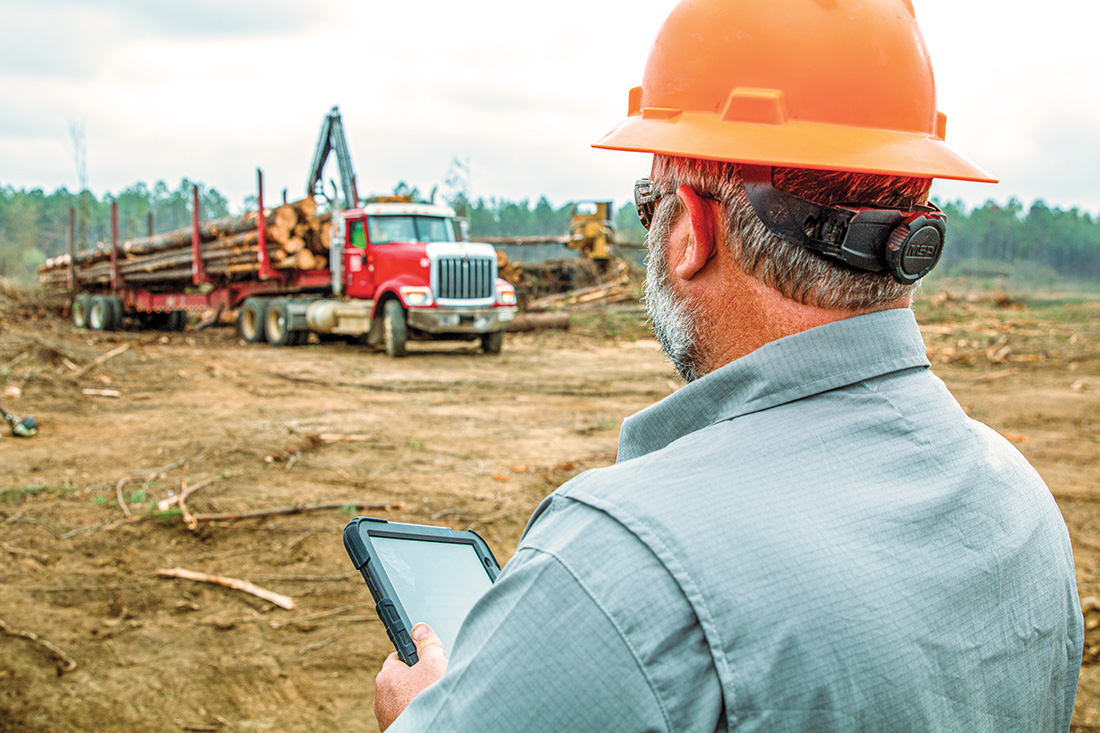
Trucks typically stay with a dedicated logging crew. Still, for added flexibility and efficiency, the team uses Samsara front-facing dash AI cameras connected to fleet tracking software to monitor truck location, loads, mileage, fuel consumption, and other key telematics data.
But even with all that on-board technology, Geiger found that trucks and drivers require constant monitoring, and he realized he was spending way too much time keeping things rolling.
“I reached a point where I hit a wall with trucking,” he recalls. “We have a great team that can handle all situations, but I knew I needed to be more focused on supporting my logging foreman and running the day-to-day operations of the business than on log trucks. There was a particular day when I counted 200 calls to my cell phone that I personally took just from drivers—I knew something had to change. I needed to get some help.”
Geiger’s decision to hire Greg Reynolds last summer to manage the fleet has proven to be one of his most effective moves in years.
Reynolds brings a wealth of experience to the new role. After a career in the oil fields, he spent almost a decade as a truck driver, gaining extensive over-the-road experience and becoming well-versed in USDOT and Federal Motor Carrier Safety Administration (FMCSA) regulations. His background as a contract hauler for Geiger, where he operated and maintained his own fleet, made him a seamless and strategic addition to the management team.
“I brought Greg on as my fleet manager to handle dispatching, manage drivers, and keep up with scheduling maintenance for the trucks and trailers,” he says. “Dispatch is a pivotal role of any trucking operation, and I felt we could bring that same kind of strategy and efficiency to the woods.”
Reynolds shifts trucks around to reduce deadheads back to the job site. He monitors drivers with GPS tracking software and knows exactly where each truck is, what they are hauling, and to which mill.
“So much of logging is come and go and come again,” Geiger says. “If we pick up 5, 6, 7, or even 8 more loads a week, and maybe cut a few miles down by shifting drivers around, it adds up quickly and makes a difference.”
Another benefit of Reynolds’s role is that he visits each of the four logging crews daily and sees each driver and their truck. He knows what maintenance is needed and can plan service intervals and repairs accordingly.
“My job is to make sure our drivers get the loads out,” Reynolds says. “We’re in the woods by 4 a.m., and we’re moving trucks around all day so the guys can get the loads they need. On a good day, each truck gets about 4 loads.”
Reynolds credits his drivers’ professionalism and hustle, along with a commitment to doing the job safely on and off the road. “It starts at the top with Mark,” he explains. “He treats everyone with respect, but is clear with his expectations, and that trickles down throughout the entire operation.
WANT MORE CONTENT?
Spanning seven decades since its inception in 1952, Timber Harvesting highlights innovative and successful logging operations across the U.S. and around the world. Timber Harvesting also emphasizes new technology and provides the best marketing vehicle for the industry’s suppliers to reach the largest number of loggers in North America and beyond.
Call Us: 800.669.5613