
July / August 2026
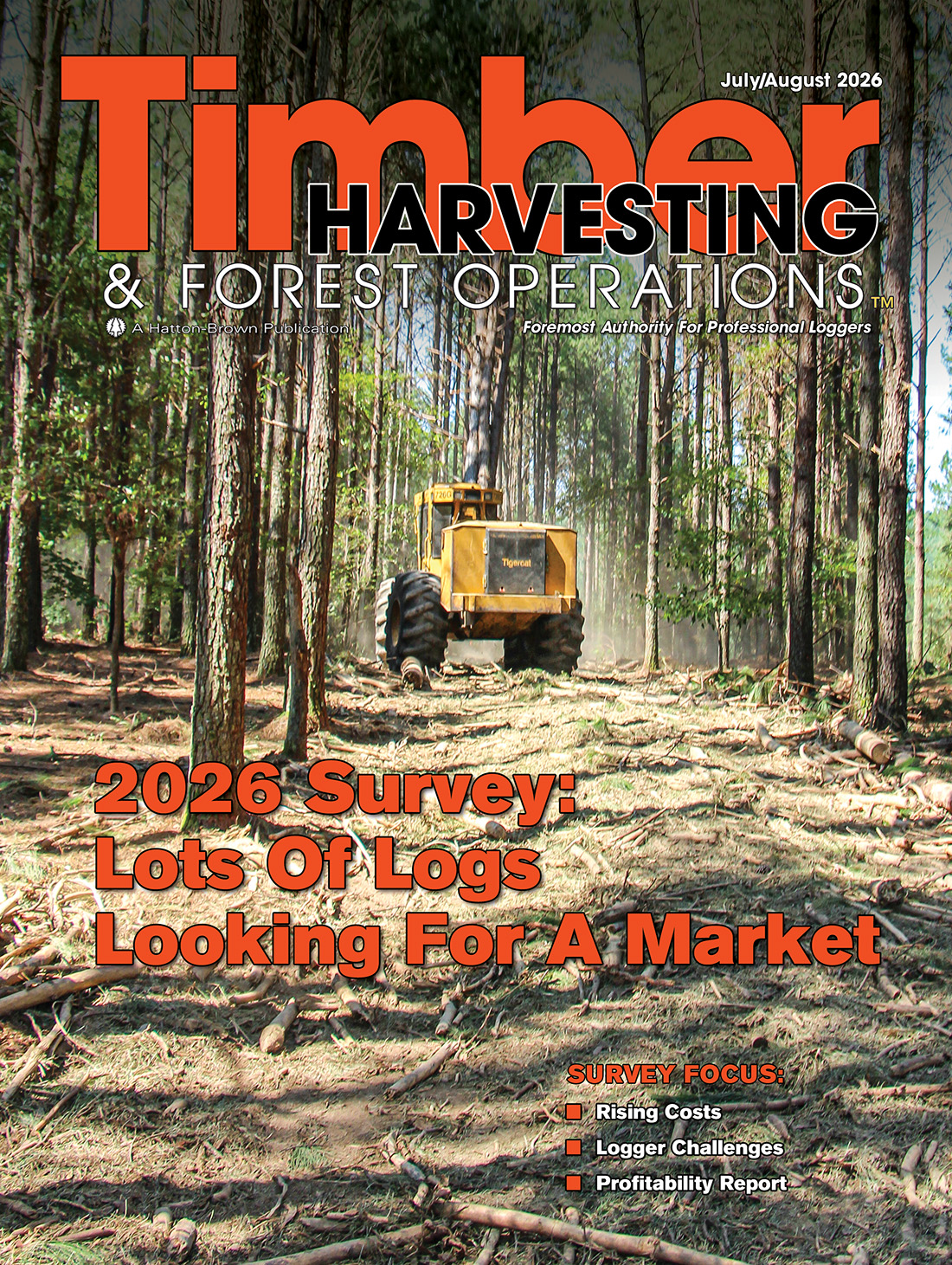
2026 Survey: Lots Of Logs Looking For A Market
The 2026 Logger Survey shows loggers hit hard by recent mill closures. Plus, rising costs are cutting into margins that were too small to begin with.
INSIDE THIS ISSUE
COVER STORY
2026 Survey: Lots Of Logs Looking For a Market
NEWSLINES
- Georgia’s McDowell Named FRA National Logger
- US Endowment Seeks Bioenergy Facility Plans
- Wilson Drake Played Key Part In Franklin
- USDA Approves Loan To Biomass Project
- 80th Annual Great Lakes Expo Set For September 10-11
- ALC’s Cupp To Serve On Trade Committee
- FS Officials Commit To Biomass Output
- Maine Program Underway: Mechanized Logging, Hauling
- Cut-To-Length Concept on Display in Alabama
- Hunt FP Closing Louisiana Hardwood Sawmill
- UK Regulators Close Drax Investigation
SURVEY SAYS...
Logging professionals across the U.S. answered this year’s Timber Harvesting Logger Survey about how business is treating them, and their responses reflected both weariness and resolve. There is widespread exhaustion due to mill closures, quotas, and the rising cost of insurance and fuel while pay rates stay flat.
There is also a quality of perseverance that keeps a one-man operation running for multiple decades and pushes a fifth-generation family business through consecutive hard seasons. The 2026 results describe a wood-products industry under real strain, but also one that refuses to fold.
This year’s 193 respondents skew toward small, owner-run operations. A solid majority (61%) run a single crew, and another 24% run two; only about 15% field three or more crewsides. More than one third (36%) have three or fewer employees including themselves, and 16% are sole operators. Total business investment lands in the $1 million to $5 million range, reported by 43% of respondents.
SELECT CUTS
- U.S. Coalition Touts Success Of Tariffs
- Komatus Helps Restoration In WV
- ALC Attends Tribal Timber Council Event
- USFS Invests In Legacy Projects
- Robbins Fire Began In Dust Silo Area
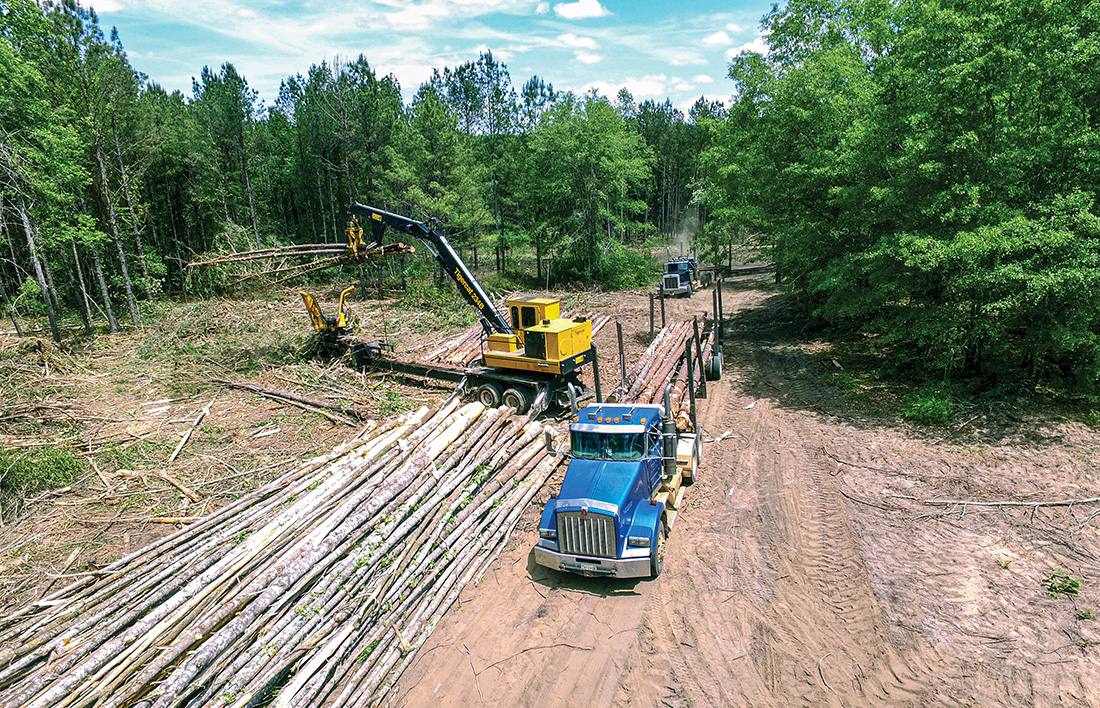
Pulp-Paper Mill Closures Reduce Logger Output
Top take-away from the 2026 Logger Survey is the impact of pulp-paper mills closures.
Story by: Dan Shell
Through all sorts of operating conditions and economic backdrop, Timber Harvesting continues to take the pulse of the forest supply chain’s logging segment with the 2026 Logger Survey.
This year, loggers almost across the board are reporting tough markets and reduced profitability as mill closures, primarily pulp and paper, wreak havoc with logging contractor finances while the paper industry continues to reduce its roundwood consumption and shift product emphasis—while paper producers in many cases are utilizing imports of cheap foreign pulp that further impact logger and landowner market demand.
Astonishingly, during the past five years since 2021, the number of loggers who said they had broke even or lost money when asked about pre-tax profit percentages has gone up by more than 30%, from 22% in 2021 to 29% last year.
The numbers are driven home even further when asked about compensation and work availability trends: In 2026, the number of loggers reporting more loads and more consistent work has gone down, while those reporting tighter quotas and rate reductions went up.
Asked about impacts in their markets, 85% of loggers reported their company had been negatively impacted by mill closures in their area the past year. Comments on the question reference mills and places that have all been in the news last year, like Idaho, Maine, Alabama, Georgia, Louisiana, just a few of the states where closures have hit the past several years.
Of those loggers affected by closures, 79% say they lost production due to log markets closing in their area. Forty percent of loggers impacted say they’ve lost between 10%-20% of annual production, while 28% of loggers have lost 20%-30%. Amazingly, 18% of those responding say they have lost more than 30% of annual production as a result of mill closures.
Loggers who commented on their financial health note that in what has always been an up and down industry, rising costs in a time of shrinking markets mean there’s a lot more down the past few years and very little up: “We lack the cash reserves large enough to weather poor economic conditions,” said one. “Profit margins are so low we can’t afford to replace the equipment we’re wearing out,” said another. “We are very diversified. Otherwise we would be in poor financial health,” commented another logger.
Looking at the past two years of compensation and workloads, 43% of loggers report tighter quotas at the mills they haul to, and another 23% say they’ve seen rate reductions. While 24% of loggers say things have been moving along with no real changes, less than 10% overall report positive developments like rate increases (5%), fewer quotas and more loads (2%) and more consistent work (2%).
The survey asked about pulpwood demand the next two years: Roughly half (52%) of loggers say they expect their pulpwood markets to remain the same, and 41% say they expect pulpwood demand to diminish in their area, while 6% expect a slight improvement. Interestingly, of the 190+ loggers who answered the question, not one, a big fat zero, chose the “improve significantly” answer. You’d think out of 190 loggers someone would have positive insight into their future pulpwood markets, but no.
Asked about current operations at or near capacity, 25% of loggers in spring 2026 report that they are running at 90%+ capacity (14%), or wide open full capacity (11%). Another 31% of loggers say they are running at 70%- 90% capacity, and 22% report they are at 60%-70%. Significantly, 22% of loggers report lower operating capacities, with 9% reporting 50%-60% capacity operations, and 13% say they are operating under 50% capacity.
WANT MORE CONTENT?
Spanning seven decades since its inception in 1952, Timber Harvesting highlights innovative and successful logging operations across the U.S. and around the world. Timber Harvesting also emphasizes new technology and provides the best marketing vehicle for the industry’s suppliers to reach the largest number of loggers in North America and beyond.
Call Us: 800.669.5613