
ALC Seeks Additional PATHH Funding
The need and success of the Pandemic Assistance for Timber Harvesters and Haulers (PATHH) was demonstrated by more than 5,600 applications representing eligibility for $385 million in aid, according to American Loggers Council. Unfortunately, this figure is nearly double the $200 million appropriated for the program.
As a result, the Farm Service Agency had to implement an assistance formula modification which resulted in reduced financial assistance ranging from 10%-57% compared to initial estimates. This adjustment was a necessary action to ensure that all eligible applicants received some level of assistance.
American Loggers Council anticipated this might be the case based on multiple economic impact studies conducted by ALC and the U.S. Forest Service, which indicated that COVID-19 induced negative economic impact to the timber industry exceeding $1 billion.
Upon this final determination the ALC traveled to Washington, DC and met with key Congressional Appropriations Committee members and expressed a need for supplemental funding to ensure full assistance is provided to the timber industry as originally intended. This information and message was also conveyed to the White House.
ALC Executive Director Scott Dane, in a letter to Congress, while noting the success of PATHH, also pointed out that due to the adjustments “in many cases the amount of financial assistance was reduced to less than half of what the applicant would have been eligible for. As an example, an applicant that would have been eligible, based on their gross income loss multiplied by 80% (original formula), for $180,000 would have been limited to the maximum of $125,000.”
Dane noted that the new formula, due to the excess request for assistance, limits the maximum to $75,000 and then applies a multiplier of 70.5% to that figure resulting in a maximum limit of $52,875. This is 42% of the original formula assistance level. Additionally, where the original assistance formula would have provided for 80% of the gross revenue loss, the new formula only provides 70.5% of the gross revenue loss.
“This level of need is evidence of the economic impact that the COVID-19 pandemic has had on the American timber industry,” Dane stated. “Multiple economic analysis reports indicated that the economic loss exceeded $1 billion. Now that the real economic need has been verified, and to meet the intent of Congress in providing adequate assistance to this vital industrial sector, a supplemental appropriation of $185 million (as per Farm Service Agency data) needs to be appropriated.”
Dane pointed out that additional supplemental appropriations have been provided for other disaster and assistance programs when the demand exceeded the initial funding appropriation.
“The American Loggers Council, and the timber industry that we represent, is extremely appreciative of the PATHH program assistance. The program’s success has exceeded expectations and has received bi-partisan support in both the Senate and House, as well as Administration support. Unfortunately, the success of the program has also revealed the extent of economic impact, loss and need within the timber industry sector. Therefore, the American Loggers Council respectfully requests an additional
supplemental appropriation of $185 million.”
Related Articles
Latest News
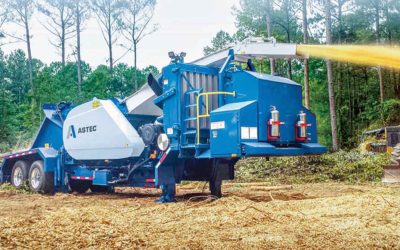
Astec, Bejac Announce Distribution Agreement
Astec has announced Bejac Corp., a heavy equipment dealer with 10 locations, will represent the Peterson line of forestry and environmental recycling equipment in California and Arizona. Bejac, founded in 1953 operated as an underground pipeline contracting business until 1985 when the company pivoted to the heavy, specialty equipment sector. In 2008, Bejac rapidly expanded its product line offerings and now focuses on a diversified customer base that complements Astec growth strategy…
J.M. Huber Corp. Receives Management Honor
J.M. Huber Corp. (Huber) has proudly announced it has been selected as a 2023 U.S. Best Managed Company Gold Standard honoree. Sponsored by Deloitte Private and The Wall Street Journal, the program recognizes outstanding U.S. private companies and the achievements of their management teams. The 2023 designees are U.S. private companies that have demonstrated excellence in strategic…
WANT MORE CONTENT?
Spanning seven decades since its inception in 1952, Timber Harvesting highlights innovative and successful logging operations across the U.S. and around the world. Timber Harvesting also emphasizes new technology and provides the best marketing vehicle for the industry’s suppliers to reach the largest number of loggers in North America and beyond.
Call Us: 800.669.5613