

Equipment World
Equipment & Supplier News
Harvesting technology, the emerging biomass sector, exposure to customers and potential customers, exchanges with equipment dealers and manufacturer reps are opportunities offered by the Mid-South Forestry Equipment Show. The biennial event is set for Friday and Saturday, June 6-7, at the John W. Starr Memorial Forest (state highway 25 south) near Starkville, Miss.
Educational sessions will be offered for loggers, foresters and landowners. Topics include business planning, trends in wood supply systems, risk management, Mississippi Loggers Assn. programs, biomass energy production, ethics in forestry, power line safety, hardwood management, the effects of logging damage and more. Also, Mississippi State forestry professors Bill Stuart and Laurie Grace will orchestrate a Loggers Roundtable Discussion from 9 a.m. to 2 p.m. on Saturday.
Feature

Another Chapter Written by David Abbott
Norval Conner, 60, and his son Jamie, 37, share more in common than their surname. Though they represent different generations of loggers, both love working in the woods, and both have enough experience to share similar perspectives on the state of the industry. Their verdict: it ain’t what it used to be.
That can be both a positive and a negative. On one hand, Norval believes younger people starting in the business today have an advantage in some ways, especially compared to the limited opportunities he had when he was in their position. “I was 30 before I could get a bank note for myself,” he recalls. Today, he says, a young logger who manages his money well can accumulate a lot in the first five years.
'Ax Men' TV Show
Those with some form of sender identification appear first. Thanks for responding. See new poll on page 24.

Clearing Down, Mulching Up by David Abbott
Butch Diller and his brother-in-law, Robert Derrickson, both 51, are the owners of RRD Land Clearing here. Diller oversees field operations while Derrickson handles the business and accounting side. RRD’s primary function is a subcontractor to clear land, usually for construction companies. Jobs range from one to 50 acres. The company clears over 200 acres a year.
Currently, though, the economy and the depressed housing market have slowed this side of the business. Diller says some of the contractors with whom he usually works have few jobs on the horizon. Fortunately, RRD’s side businesses are faring better.

Feller-Buncher Roundup
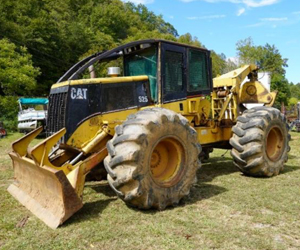
Caterpillar track and wheel feller-bunchers are built with proven Cat components and supported through the corporation’s international dealer network.
Recent enhancements to its zero tail swing and full tail swing track-type machines have resulted in a 40% improvement in performance. Models in the new Cat 500 series climb steep slopes while simultaneously operating boom, stick and tool functions. A 44% improvement in tool force capacity allows the operator to pick up and place larger trees precisely, increasing overall productivity.

Handling Biomass by Scott Jamieson
If Mark Ryans and Luc Desrochers could get one message across to folks entering the forest biomass recovery business, it’d be to integrate this new task into the rest of the forest value chain.
“Right now, a lot of operators are trying to recover forest biomass that has essentially been seen as waste by everyone who came before them. So in all the previous harvesting operations, it has been treated accordingly—driven on, piled quickly just to push it out of the way, scattered or contaminated. It all makes recovery now harder and more expensive,” Ryans explains.

Northwest Timber Salvage by Dan Shell
Northwest loggers are still working in many areas to harvest timber damaged during major December windstorms that affected more than half a billion board feet in a concentrated area in northwest Oregon and southwest Washington. The damage occurred within a relatively narrow band along the coast and a bit inland along the Columbia River.
According to the National Weather Service, the December 1-4 event included multiple winter hazards: snow, hurricane-force winds, heavy rainfall, major flooding and landslides.

Timely Reevaluation by Tonya Cooner-Vots
Land ownership changes and mill closures have caused Kevin Jester, owner of K.W. Jester Logging, Inc., to pause, step back, reevaluate and step forward. Even though he has postponed making machinery purchases he believes will make his business more efficient and profitable, Jester, 36, remains enthusiastic about logging’s future in his area and plans to be in the thick of it years down the road.
A long-time contractor for IP, he switched over to TimberStarSW a few years ago when that company bought 900,000 acres of IP timberland. Earlier this year, TimberStarSW announced it was selling its land to John Hancock.
Letters
Readers, Writers, Riders
The quotes from the Timberlines editorial disturb me. Both apparently come from procurement big shots at paper companies. The statements were as follows: “If we’re not losing 10% of our loggers each year, we’re paying them too much.” And “Loggers are like pencils. You break one, you reach for another.”
As a procurement forester for a grade hardwood sawmill in southwest Pennsylvania, I am both embarrassed and outraged to see such ignorant statements. Unfortunately, if a procurement operation anywhere has only lost 10% of its logging force in the last 18 months, it is better than most, but I think that box of pencils is running slim. These company chuckleheads are the “hell bent to beat the budget” types that leave mass chaos in their wake as they climb the corporate ladder. Hopefully, they are a minority.
Mooney's Corner
Refine Your Approach To Fuel Management by Jim Mooney
Soaring fuel prices have just about everybody wringing hands these days. Consumers and businesses struggle with the burden while oil companies ring up record profits. In 2004 off-road fuel was around $1.40 per gallon. In early 2008 it hit $3.50 per gallon and by early April road fuel broke the $4 plane and kept going. Fuel surcharges and rate increases are the norm for couriers, over-the-road trucking companies and such. Unlike others, loggers have no way to pass along higher fuel costs. With alternative energy sources still in the distance, what can a logger do today to stretch fuel dollars?
Product Showcase
New Products & Technologies
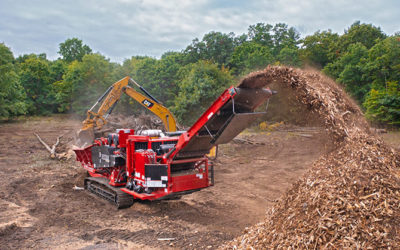
The Vermeer HG4000TX self-propelled horizontal grinder allows the operator to effectively maneuver around landclearing, compost or forest thinning jobs without the need for additional support equipment. The 440 HP (330-kW) Tier 3 diesel engine powers the exclusive duplex drum, which features 8 hammers and 16 cutters. The reversible hammers and cutter blocks last nearly twice as long as single-sided designs.
Top-loading screens offer easy access and a removable anvil allows for convenient maintenance or replacement. The exclusive SmartGrind feature stops and reverses material from feeding into the hammermill when engine RPM drops below an efficient operating range. A 48" wide (122 cm) single-discharge V-cleat belt provides a smooth, efficient transfer of processed material from the belly of the machine to the load out.
Select Cuts
As I See It: Taking Control by Ezell Castleberry
There are several issues impacting the industry at this time and they are basically things that we, as loggers, have no control over. Rising fuel prices have helped to highlight the other issues such as a devalued dollar, sub-prime mortgage defaults, depressed lumber markets and ever-rising costs of operations. To our disadvantage, we are also in the middle of an election year in which members of Congress appear to be more interested in remaining neutral on many of the issues so as to not discourage anyone from voting for them. If we are waiting for help from our elected officials, chances are better of a snowball staying frozen in hell than expecting them to do something this year.
Developments, Meetings
Forest Resources Assn. named Babineau Logging, Inc. of West Enfield, Me.—owned by David and Kurt Babineau—as its 2008 National Outstanding Logger at its April 13 Annual Awards Luncheon in Myrtle Beach, SC. FRA Chairman Jim Brody presented them with a plaque on behalf of the FRA Board. Kent Hall of Stihl presented them with a $1,000 check.
FRA awarded its 2008 National Outstanding Forestry Activist Award to John Bradley, of Bradley Contractors, Inc., Jefferson, Texas, and its 2008 Technical Writing Award to Joel Cathey of Keysville, Va.’s Ontario Hardwood Co. and Dan Goerlich of Virginia Cooperative Extension.
Timberscope
Industry News
Catalyst Paper, Vancouver, BC, reportedly can no longer get enough wood chips to keep all its coastal pulp and paper mills running, singling out fiber shortages as a key factor in the company’s poor performance in the first quarter.
The fiber shortage is mostly caused by BC sawmill closures in the wake of the U.S. housing market collapse. Catalyst lost 42,000 tonnes of paper production and 22,000 tonnes of pulp production during the quarter due to the wood chip shortage, the company reported.