
ALC Rising To Challenges
Article by Dan Shell, Managing Editor, Timber Harvesting November/December 2022
One really bright spot concerning the American Loggers Council is the organization’s resilience as the pandemic slowly fades away: Many organizations and trade associations took a beating during the pandemic, but the ALC is surviving remarkably well and moving ahead on a variety of fronts.
Two news items this month underline the importance of having an association like the ALC to provide a national voice for the logging industry as various issues come up.
The news that Strategic Biofuels in Louisiana is working with the Forest Service and other groups on biomass standards is big news. Developing a Renewable Fuel Standard system to make it easier to incorporate forestry feedstock into biomass and green energy initiatives and projects by ensuring raw materials meet sustainability standards and qualify for various favorable state and federal tax policies is going to make utilization of woody biomass more attractive— and that’s good for the logging industry.
Having such a system is yet another tool to aid in the increased utilization of wood as a sustainable energy source. Strategic Biofuels is taking the lead in developing an auditable system to track feedstock qualifi cation, source-origin and chain of custody data to support its Louisiana Green Fuels project that will use woody biomass to produce renewable diesel and naphtha.
Julie Tucker, National Wood Innovations Program Manager of Bioenergy, Biofuels, and Bioproducts, U.S. Forest Service, notes that “Historically, forest residuals have been a disposal challenge. The Renewable Fuel Standard helps change that by giving the renewable energy sector a fi nancial incentive to convert these unwanted forest residuals to high value biofuels and renewable electricity.”
While the development group is being led by the Forest Service and Strategic Biofuels and the full team is still being assembled, members will include representatives from the National Assn. of State Foresters and the American Loggers Council as well as groups representing industrial and non-industrial landowners, tribal interests and others. It’s critical to have ALC involved as part of the process to help develop such a system that has national implications for increased biomass utilization—and help ensure loggers’ concerns are heard as biomass standards and tracking systems are established.
NW Chips Explode
Interesting note in the most recent North American Woodfi ber & Biomass Markets newsletter from Fastmarkets RISI that chip exports are taking off in the Northwest, with Douglas fi r chip prices at West Coast shipping terminals recently setting all-time highs.
Reasons behind the strong markets include now-familiar supply chain issues but also true growth pending in the export market, according to RISI.
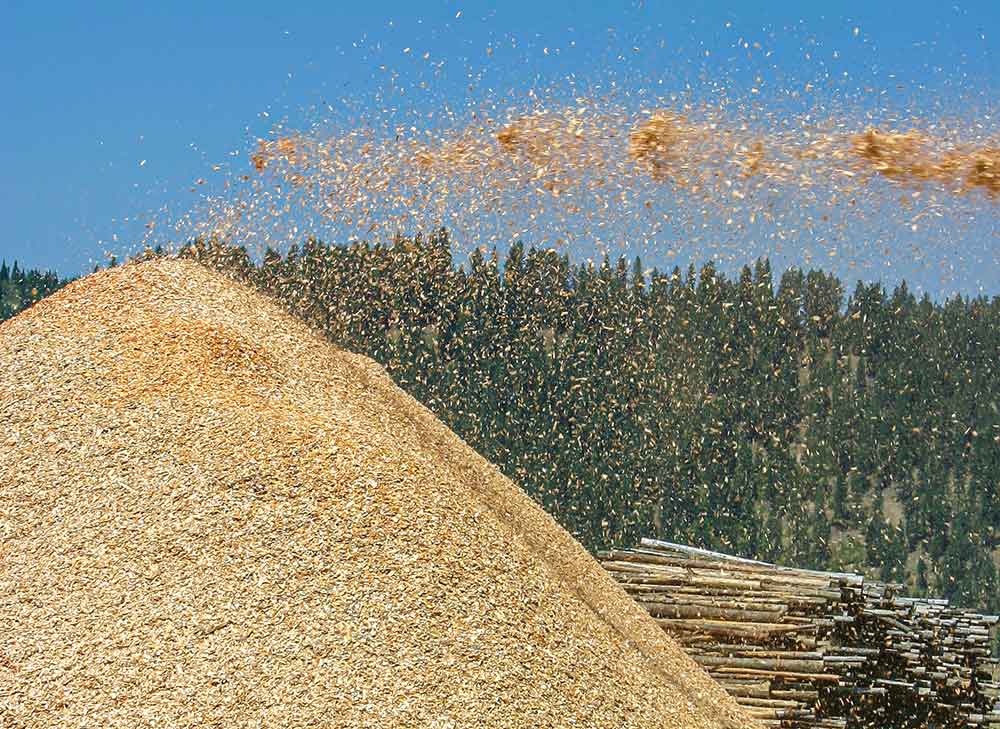
Currently, slowing lumber production on the West Coast and strikes at multiple Weyerhaeuser sawmills have made chips harder to source. Japanese demand is also up thanks to black liquor green energy credits being offered to Japan’s paper sector. Complicating the market, there are also West Coast chip mill projects currently hit with construction delays, the newsletter said.
Longer term, there are ongoing pulp capacity expansions in China, according to Fastmarkets RISI analyst John North. Those capacity increases will greatly expand demand for chip imports and that will have long-term impacts on global markets going forward, he added.
Remember these market dynamics are occurring without a major wood energy demand from Asia. If economies such as Japan, Korea and China move toward signifi cant pellet consumption as Europe has it would be a fi ber market game changer on the West Coast.
Highest Value Use Wins?
The other news item that bears watching in context of larger developments is the recent purchase of 29,000 acres in Michigan that will be used to create “carbon projects” by a joint venture and management company that’s already managing more than 90 forest carbon projects across 4 million acres.
So far, so good, until you read that no logging is planned until some level of forest growth is achieved, and then a selective logging program will be offered at some future date. Again, so far, so good—everyone pursuing their economic interests—until you realize that’s 30,000 acres essentially taken out of production.
A future selective logging program is on the drawing board, but nothing is planned.
At the ALC meeting in 2021 in Couer d’Alene, Id., ResourceWise CEO Pete Stewart (parent of Forest2Market) spoke on this very topic of carbon credits and said it bears watching closely: That the fi nancial industry’s expansion of carbon credit markets may eventually lead some to view forestland as valued more as an accounting entry that mitigates polluters’ smokestack impacts than as a source of sustainably managed forest products and associated businesses and jobs.
It’s defi nitely a trend that bears watching closely.
Latest News
California Adds To State Demo Forest
Officials with the California Dept. of Forestry and Fire Protection (Cal Fire), recently announced the addition of more than 2,500 acres to its demonstration state forest system, which increases opportunities for critical research, forest restoration and public recreation. The two new properties include 2,246 acres in Shasta County and 267 acres in the headwaters of the Bear River in Nevada and Placer counties…
Wisconsin Launches Forest Workforce Development
Wisconsin state officials, including Gov. Tony Evers, University of Wisconsin-Stevens Point (UWSP) Chancellor Thomas Gibson, UWSP College of Natural Resources Dean Brian Sloss and others, recently came together on the UW-Stevens Point campus to celebrate the announcement of approximately $8 million in Workforce Innovation Grant funding for the Wisconsin Forestry Center at UWSP for their Forest Industry Workforce Recruitment and Development Initiative…
Upgrade From John Deere: Knuckleboom Loaders
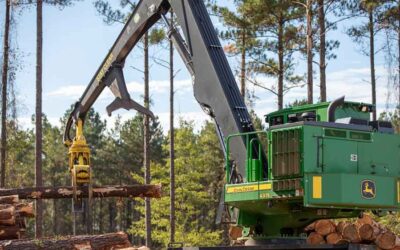
John Deere introduces the latest updates to its knuckleboom loader lineup, including visibility enhancements. Aiming to increase operator safety and accuracy, the 2022 models of 437E and 337E knuckleboom loaders feature a newly designed front window by removing the external mesh guard and replacing it with a clear, polycarbonate window for uninterrupted view…
WANT MORE CONTENT?
Spanning seven decades since its inception in 1952, Timber Harvesting highlights innovative and successful logging operations across the U.S. and around the world. Timber Harvesting also emphasizes new technology and provides the best marketing vehicle for the industry’s suppliers to reach the largest number of loggers in North America and beyond.
Call Us: 800.669.5613